Thursday, March 17, 2016

Nymphs Part 2: Mountain Nymph

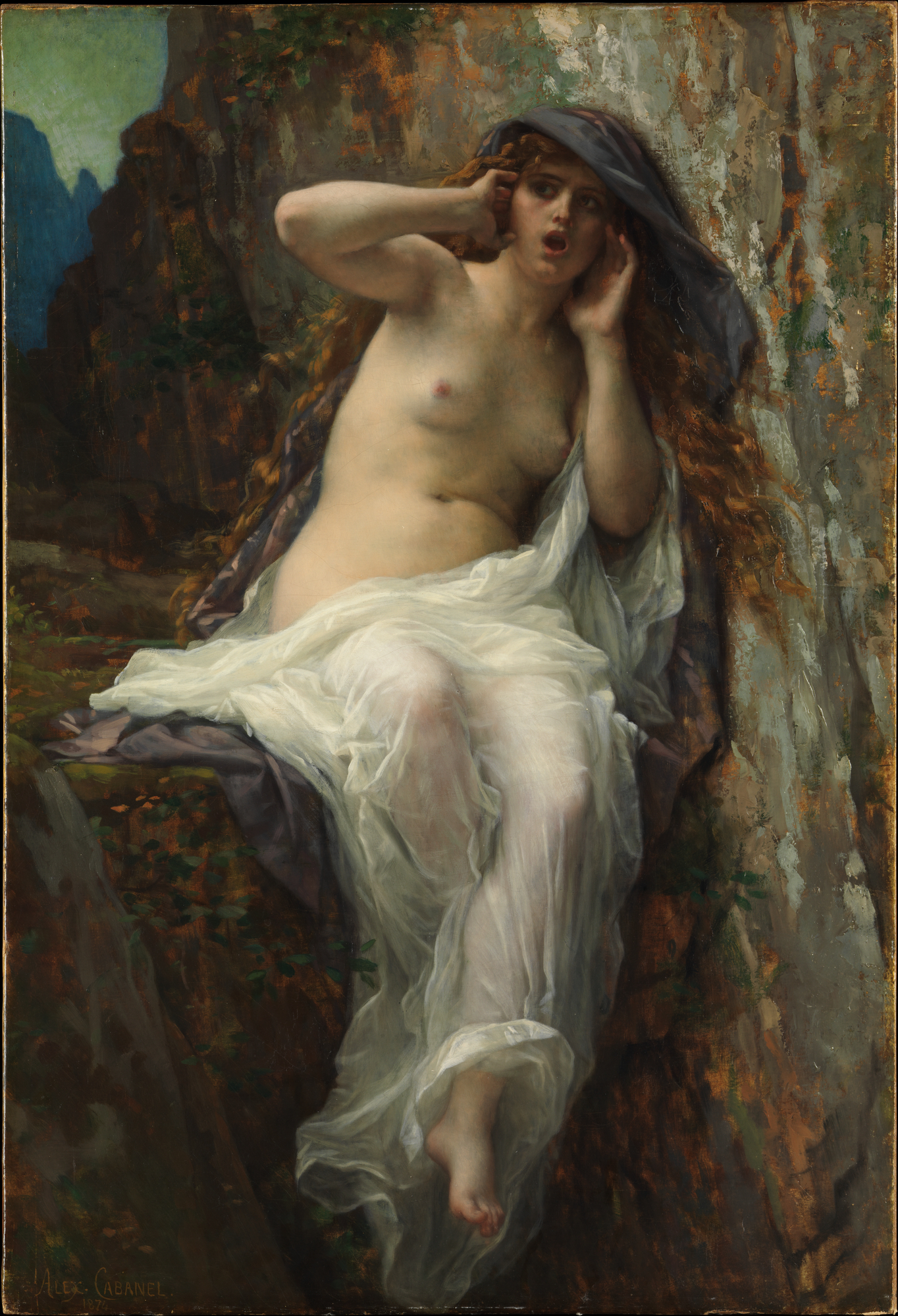
The crystal clear water of the icy pool shimmered and rippled in the still air of the morning. Gradually, the ripples grew in an upward undulation that formed shapely calves, then thighs, and eventually a fully formed woman of surpassing beauty.
Nymphs are loci geniuses that inhabit various natural places. While similar to what are sometimes called “fae”, they more closely resemble elementals of a specific locale. They are inherently tied to the location they inhabit; indeed, their very existence depends on the wellbeing of the environment. And they defend it vehemently.

All nymphs exercise a measure of control over their homes and use this, in combination with their preternatural beauty to ward off attacks. Their beauty is terrible and captivating, and they use this mercilessly to their advantage.

As dangerous as nymphs can be, they are excellent sources of information on the area in which they dwell, and if befriended, they make powerful allies. However, their legendary shyness makes this difficult, and their sadistic impulses make it doubly dangerous!

Mountain Nymph

CER 73 (OR 27 and PR 46)
Mountain nymphs are spirits of place who watch over mountainous areas.  They are closely attached to particular passes, grottos, peaks, etc., and may not stray more than a short distance from them without becoming seriously ill.  They defend their homes fiercely, employing magic to animate the mountain itself, often while dancing about high above.  All mountain nymphs command great knowledge about their environment.
ST: 9                                                       HP: 10                                                    Speed: 6.00
DX: 12                                                    Will: 10                                                  Ground Move: 6
IQ: 10                                                     Per: 11                                                   Climbing Move: 6
HT: 12                                                    FP: 12                                                     SM: 0

Dodge: 9                                                Parry: 10 (Unarmed)                           DR: 5

Punch (14): 1d-1 crushing. Reach C.
Quarterstaff (14): 1d+1 crushing (swing) or 1d crushing (thrust). Reach 1, 2*.
Animated Environment: Mountain nymphs can animate the environment around them to slide or knock intruders from their feet (target takes 3d crushing double knockback no wounding), strike at them (1d crushing or impaling) with rocks from above, or cause the ground to partially swallow a person – treat as Binding 10.
Difficult Terrain: A mountain nymph can cause anyone within their domain to have difficulty maintaining their balance or moving about.  The victim must roll a Quick Contest between his Will and the nymph's Will.  On a failure, the subject suffers a -2 penalty to DX and -2 penalty to Acrobatics, Jumping, Climbing, and Skiing lasting a number of minutes equal to his margin of failure.
Stunning Beauty: By striking even the slightest pose, anyone who sees her must make a Fright Check at -5 and roll on the Awe table.
Threshold Entity: This being doesn’t breathe, drink, eat, or sleep, is immune to metabolic hazards, and is either insubstantial and invisible or substantial and visible.

Traits: Acute Hearing 2; Appearance (Very Beautiful; Universal); Berserk (9) (Special Trigger, harming the wilderness); Callous; Can Be Turned by True Faith; Curious (15); Dependency (Home Mountain; Daily); Dislikes Loud Noises; Divine Curse (Keep to the letter of any promise); Fearlessness 2; Higher Purpose (Protect Home Mountain); Impulsive (12); Odious Personal Habit -1 (Capricious); Perfect Balance; Sadism (15); Sense of Duty (Home Mountain); Shyness (Mild); Super Jump 1; Terrain Adaptation (Mountain); Unaging; Vulnerability (Iron x2).
Features: Affected as Spirit.
Skills: Area Knowledge (Local)-12; Brawling-14; Climbing-16; Dancing-16; Intimidation-17; Jumping-16; Naturalist-12; Quarterstaff-14; Sex Appeal-12; Stealth-14.
Notes: Most nymphs won't negotiate because they are too shy.  Those who do are amiable enough, but dealing with such an astounding beauty is often disconcerting – especially while under the effect of her intoxicating beauty (see above).  Always scars from wounds inflicted by iron.

Monday, March 14, 2016

This Time It IS Rocket Science!

This time, I’m going to get into how I make rough apogee predictions for model rockets. Below is a derivation of the formulas necessary for predicting the apogee of a spherical bovine rocket undergoing air drag.

Warning: Math Ahead


So ultimately, we want to know how high the rocket will go. I am going to call this “y”, “displacement” or “apogee” interchangeably. I might even call it the height. Either way, this is what we are ultimately trying to solve for.

Anyone who has taken a basic calculus or physics class probably recognizes a few truths:
and
That is to say, the change in location of an object over a period of time is its velocity, and its change in velocity over a period of time is its acceleration. Thankfully, we can also say this in reverse:
and
This becomes important when we consider that the flight of any object is based on the sum of the forces acting on it. This is grounded in Newton’s Laws of Motion. Thus we know that the sum of our forces is

where F = force, m = mass, and a = acceleration. Thus,

Now we have a few terms here that we need to sort out: FThrust, FDrag, and FWeight. Of these, we can generally not worry about FThrust because that information is available based on our motor. Likewise, we know that FWeight = mg, where g is the acceleration due to gravity. This leaves FDrag for us to define:

where ρ = the density of air, CD = the coefficient of drag, A = the crossectional area of the rocket, and v = the velocity. This may seem like a lot of information, but much of it really doesn’t change with time for our purposes here. So I am going to combine a bunch of these into a constant. I will do this a few more times to clean up equations and put them in more easily recognizable forms, too.

Now we have a simpler looking equation:
Substituting this and the formula for FWeight, we get:
One more substitution, referring back to the beginning gives us
and we are ready to separate the variables and integrate.
But first, we are going to use some algebraic manipulations to get this looking like something we can integrate more easily:
Let
Thus
Now it’s time to integrate both sides:
Both m and k are constants, so we pull those out and integrate the right side:
We should now recognize the integral on the left as tanh-1 u:
By the definition of tanh-1, we can perform the following manipulations:
Therefore,
And define the constant
This lets us say:
Raising both sides to the e power gives:
Then we multiply both sides by the denominator:
Expanding the right side gives us:
Next, I need to isolate my v’s on one side:
Next, factor out v:
And divide both sides by (-ext-1):
Put more neatly:
And thankfully, we know that t = impulse divided by thrust, both of which are specifications provided by our motors. So now we know the final velocity when the motor finishes burning its fuel, but that doesn’t tell us either how high the rocket is at that point or how far it continues to coast. For that information, we need more integration.

We will begin by solving for yBurn, or how far the rocket travels while the motor is still providing thrust. For simplicity’s sake, we will assume the rocket’s weight does not change during this time (we are launching a frictionless spherical cow, aren’t we?), so m will continue to refer to the mass of the rocket while it is full of propellant.

Referring back to our original equation, we know that:
So we can say
By separating the variables and integrating both sides, we get:
Which becomes:
Now we know the rocket’s altitude when the motor cuts out, but the rocket won’t instantly stop; it will continue to coast. So let yCoast = the distance the rocket coasts on its momentum before beginning its descent. That is to say, how far will the rocket travel upward once FThrust = 0. Note that since the rocket has exhausted all of its fuel, we no longer use mFull – we are now use mEmpty.
This should all look a bit familiar, but not that because FThrust = 0, that term is simply missing:
By integrating both sides, we get:
Which becomes:
Now, we know the rocket’s apogee will be the sum of how high it goes while under power (yBurn) and how far it coasts before the acceleration due to gravity starts returning it to Earth (yCoast):
And there you have it! To summarize:


Where,
A = the area of the rocket’s cross-section normal to its velocity vector.
CD = the rocket’s coefficient of drag.
FThrust = the motor’s thrust in Newtons.
g = the acceleration due to gravity.
I = the motor’s impulse in seconds.
mEmpty = the mass of the rocket after burnout.
mFull = the mass of the rocket at liftoff.
ρ = the density of air.

Of course, the astute reader will notice that through all of that mess, there is one term still undefined- CD. This is the coefficient of drag, and determining it generally requires experimentation or running simulations. For my purposes, that is where OpenRocket and SolidWorks come in. Both are capable of determining CD.

Did you survive? I warned you there’d be math!


Monday, March 7, 2016

It's Not Rocket Science!

Today's post was going to be a derivation of the formulas I used to predict a rocket's performance. It does get pretty math-intensive, and so I wrote it out ahead of time in word to more easily proof before pasting into here. This was a mistake. The formulas didn't transfer. Not only that, but I'm still looking for a good way to put them and any future math I may decide to include, in this blog. So instead of math, you're getting a llama.


Was this better than a few pages of integration?

Sunday, February 21, 2016

Puissant Weapon (Sorcery)

Today's entry is a spell commonly used to enchant weapons:

Puissant Weapon

Key Words: Weapon Buff.
Full Cost: 17 points for level 1, 23 points for level 2, and 30 for level 3.
Casting Roll: None. Use Innate Attack (Gaze) to aim.
Range: 100 yards.
Duration: 3 minutes.

The enhanced weapon inflicts more damage for the duration. Add the spell’s level to the basic damage inflicted by the weapon (maximum 3). This stacks with mundane damage bonuses, like those from Committed or All-Out Attack (Strong) or quality bonuses, but not from magical sources.

Statistics: Affliction 1 (HT; Accessibility, Only on weapons, -20%; Advantage, Puissant, +65%; Fixed Duration, +0%; Increased 1/2D, 10x,+15%; No Signature, +20%; Sorcery, -15%) [22]. Additional levels add further levels of Puissant to the Advantage enhancement (+117.5%) [+12]. Notes: "Puissant" is Burning Attack 1 (Accessibility, Only to augment damage inflicted, -35%; Magical, -10%) [0.7] + Crushing Attack 1 (Accessibility, Only to augment damage inflicted, -35%; Magical, -10%) [0.7] + Cutting Attack 1 (Accessibility, Only to augment damage inflicted, -35%; Magical, -10%) [1] + Huge Piercing Attack 1 (Accessibility, Only to augment damage inflicted, -35%; Magical, -10%) [1.1] + Impaling Attack 1 (Accessibility, Only to augment damage inflicted, -35%; Magical, -10%) [1.1] + Large Piercing Attack 1 (Accessibility, Only to augment damage inflicted, -35%; Magical, -10%) [0.8] + Piercing Attack 1 (Accessibility, Only to augment damage inflicted, -35%; Magical, -10%) [0.7] + Small Piercing Attack 1 (Accessibility, Only to augment damage inflicted, -35%; Magical, -10%) [0.4].

Energy Point Cost Table

Energy Point Cost
Weapon Type +1 +2 +3
Staff 6 9 11
Wand 7 10 12
Projectile 3 3 4
Weapon 8 11 14

Sunday, February 7, 2016

Nymphs Part 1: Cave Nymph

The crystal clear water of the icy pool shimmered and rippled in the still air of the morning. Gradually, the ripples grew in an upward undulation that formed shapely calves, then thighs, and eventually a fully formed woman of surpassing beauty.
Nymphs are loci geniuses that inhabit various natural places. While similar to what are sometimes called “fae”, they more closely resemble elementals of a specific locale. They are inherently tied to the location they inhabit; indeed, their very existence depends on the wellbeing of the environment. And they defend it vehemently.

All nymphs exercise a measure of control over their homes and use this, in combination with their preternatural beauty to ward off attacks. Their beauty is terrible and captivating, and they use this mercilessly to their advantage.

As dangerous as nymphs can be, they are excellent sources of information on the area in which they dwell, and if befriended, they make powerful allies. However, their legendary shyness makes this difficult, and their sadistic impulses make it doubly dangerous!

Cave Nymph

CER 68 (OR 26 and PR 42)
Cave nymphs are spirits of place who watch over caves, mines, and other subterranean areas.  They are closely attached to caverns, cave systems, grottos, and mines, and may not stray very far from their home domain without becoming seriously ill.  They defend their homes fiercely, employing magic to animate the stalagmites, stalactites, and loose rocks, often while hiding within rocks themselves.  All cave nymphs have great knowledge of their home caves and cannot get lost in any labyrinthine environment.
ST: 8                                                       HP: 8                                                      Speed: 6.00
DX: 12                                                    Will: 10                                                  Ground Move: 6
IQ: 10                                                     Per: 11
HT: 12                                                    FP: 12                                                     SM: 0

Dodge: 9                                                Parry: 10 (Unarmed)                           DR: 3

Club (14): 1d-1 crushing. Reach 1.
Punch (14): 1d-2 crushing. Reach C.
Animated Environment: Cave nymphs can animate the environment around them to grapple (Binding or Telekinesis) intruders with ST 10 or strike at them (1d crushing or impaling) with falling rocks or stalactites.
Gloom: Cave nymphs can exude a thick darkness through which they can see perfectly – just like any other darkness.  It is thickest up to one yard from the nymph, imposing a -10 penalty to Vision, and decreases by 1 every additional yard from the nymph.
Illumination: Cave nymphs can glow with a gentle luminescence that sheds light as a torch.  This makes the nymph stand out in the darkness and can be turned on or off as a free action.
Stonewalk: A cave nymph can see and move through stone unhindered.
Stunning Beauty: By striking even the slightest pose, anyone who sees her must make a Fright Check at -5 and roll on the Awe table.
Threshold Entity: This being doesn’t breathe, drink, eat, or sleep, is immune to metabolic hazards, and is either insubstantial and invisible or substantial and visible.

Traits: Absolute Direction; Acute Hearing 1; Appearance (Very Beautiful; Universal); Berserk (9) (Special Trigger, harming the wilderness); Callous; Can Be Turned by True Faith; Curious (15); Darkvision; Dependency (Home Cave; Daily); Dislikes Loud Noises; Divine Curse (Keep to the letter of any promise); Fearlessness 2; Higher Purpose (Protect Home Cave); Impulsive (12); Odious Personal Habit -1 (Capricious); Sadism (15); Sense of Duty (Home Cave); Shyness (Mild); Terrain Adaptation (Uneven); Unaging; Vulnerability (Iron x2).
Features: Affected as Spirit.
Skills: Area Knowledge (Local)-12; Axe/Mace-14; Brawling-14; Intimidation-17; Naturalist-12; Sex Appeal-12; Stealth-16; Wrestling-14.
Notes: Most nymphs won't negotiate because they are too shy.  Those who do are amiable enough, but dealing with such an astounding beauty is often disconcerting – especially while under the effect of her intoxicating beauty (see above).  Always scars from wounds inflicted by iron.

Sunday, January 10, 2016

Slaughtered Sense

Today's offering delves into a a bit of necromancy.

Slaughtered Sense (Ritual)

Spell Effects: Lesser Sense Spirit + Lesser Sense Spirit.
Inherent Modifiers: Area of Effect.
Casting Roll: 0 (x1).

You can perceive and speak with any spirits of those slain in battle who are within 10 yards. Not only can you sense when such ghosts are near, you can see them and can roll against your Path skill to sense their general intentions. Failure gives no answer, and on a critical failure, the GM lies!

Typical Casting: Lesser Sense Spirit (2) + Lesser Sense Spirit (2) + Area of Effect, 2 yards (8). 12 energy (12x1).

Slaughtered Sense (Sorcery)

Keywords: Buff.
Full Cost: 19 points.
Casting Roll: None. Use Innate Attack (Gaze) to aim.
Range: 100 yards.
Duration: 3 minutes.

You can perceive and speak with the spirits of those slain in battle. Not only can you sense when such ghosts are near, you can see them. Add your Magery level to any Vision rolls to notice the ghosts of the slain.
Lastly, you can sense the general intentions of any slain ghost you encounter with a successful roll against IQ + your Magery level, and can use your Influence skills on them normally.


Statistics: Affliction 1 (Advantage, Slaughtered Sense, +170%; Increased 1/2D Range, 10x, +15%; No Signature, +20%; Sorcery, -15%) [19]. Note: Slaughtered Sense is Medium (Linked, +10%; Magical, -10%; Specific, Ghosts of Those Slain in Battle, -75%) [3] + See Invisible (Ghosts) (Accessibility, Ghosts of Those Slain in Battle, -25%; Linked, +10%; Magical, -10%) [11] + Spirit Empathy (Linked, +10%; Magical, -10%; Specific, Ghosts of Those Slain in Battle, -75%) [3].

Saturday, January 9, 2016

Unnamed Mapping Project Continues

As I was working on the map from my last post, I starting thinking about the people that live there. And the first thing that sprung to mind is that this is an isolated area. The more I thought on it, the more I liked that idea. I also love the inland-ish sea. But after looking at the map I made, I noticed that the people aren't that isolated. In fact,t here's this open piece of continent to west that could lead to anything. So what did I do? I started over.

This time, I made sure the entire western coast is shown, and then continued with a similar idea. I did a better job scaling the mountains, this time, too, and am currently in mortal combat with that jagged little compass rose. I've also made a number of map symbols for placement, once I get a better idea of what is going on this map. And even better, I think I've figured out how I will blend the symbols and labels onto the map and keep things legible. Of course, time will tell if that actually pans out.

So enough rambling. Here's a map! Make sure you zoom in to see it at full detail.


What sort of land is this? What mysteries and wonders dot the region?

Sunday, January 3, 2016

A Regional Map of....I'm not sure...


This map was created using GIMP and Wilbur by following Arsheesh's most excellent Eriond Tutorial. In total, this has consumed five hours of my life that I feel are well spent. The next step will be coming up with some fun background stuff and placing cities, fortifications, roads, boarders, labels, etc. That will likely take a while just because I need to come up with all of that, still. Lastly, I'll need to drop a compass rose in there somewhere and give this thing a border - likely using another of Arsheesh's turtorials.

Looking at this again, I don't like how flat the water looks. I'll have to add some texture to that, as well. Maybe a parchmenty thing. I'll toy with it some and see what looks good.

What does this map remind you of? What sort of people do you think live here?